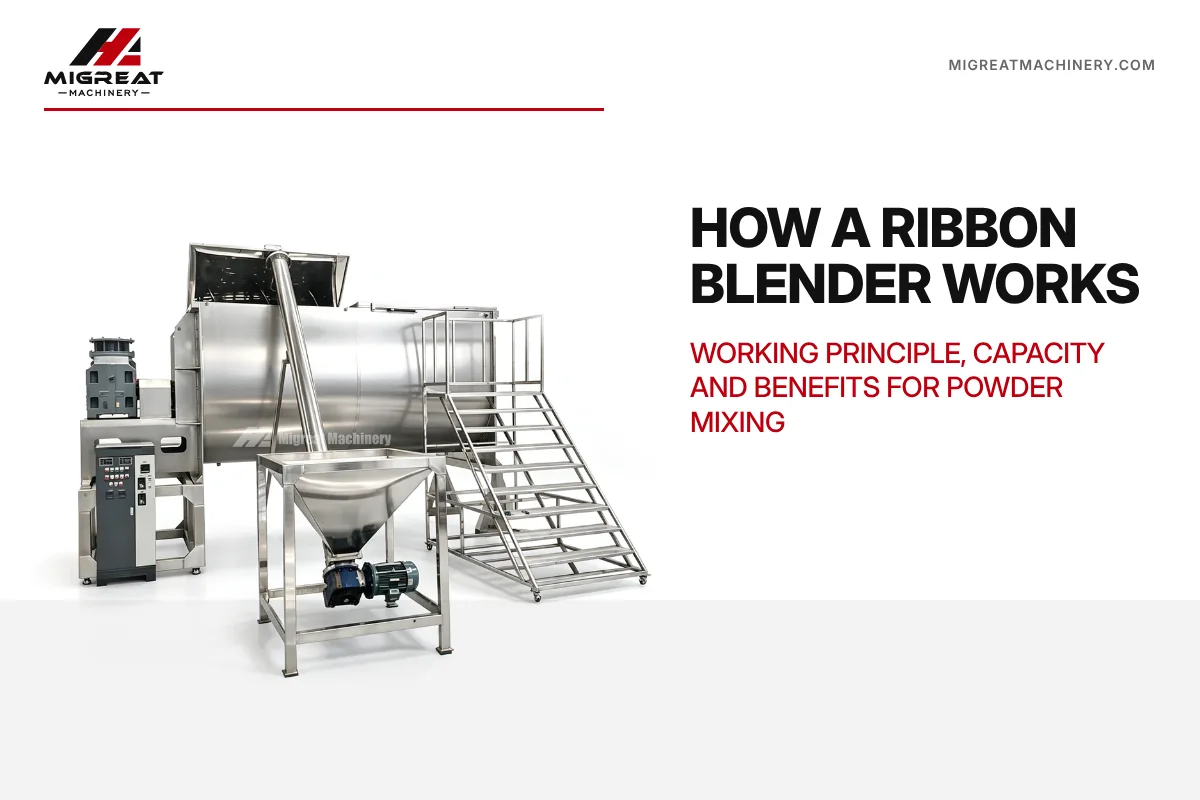
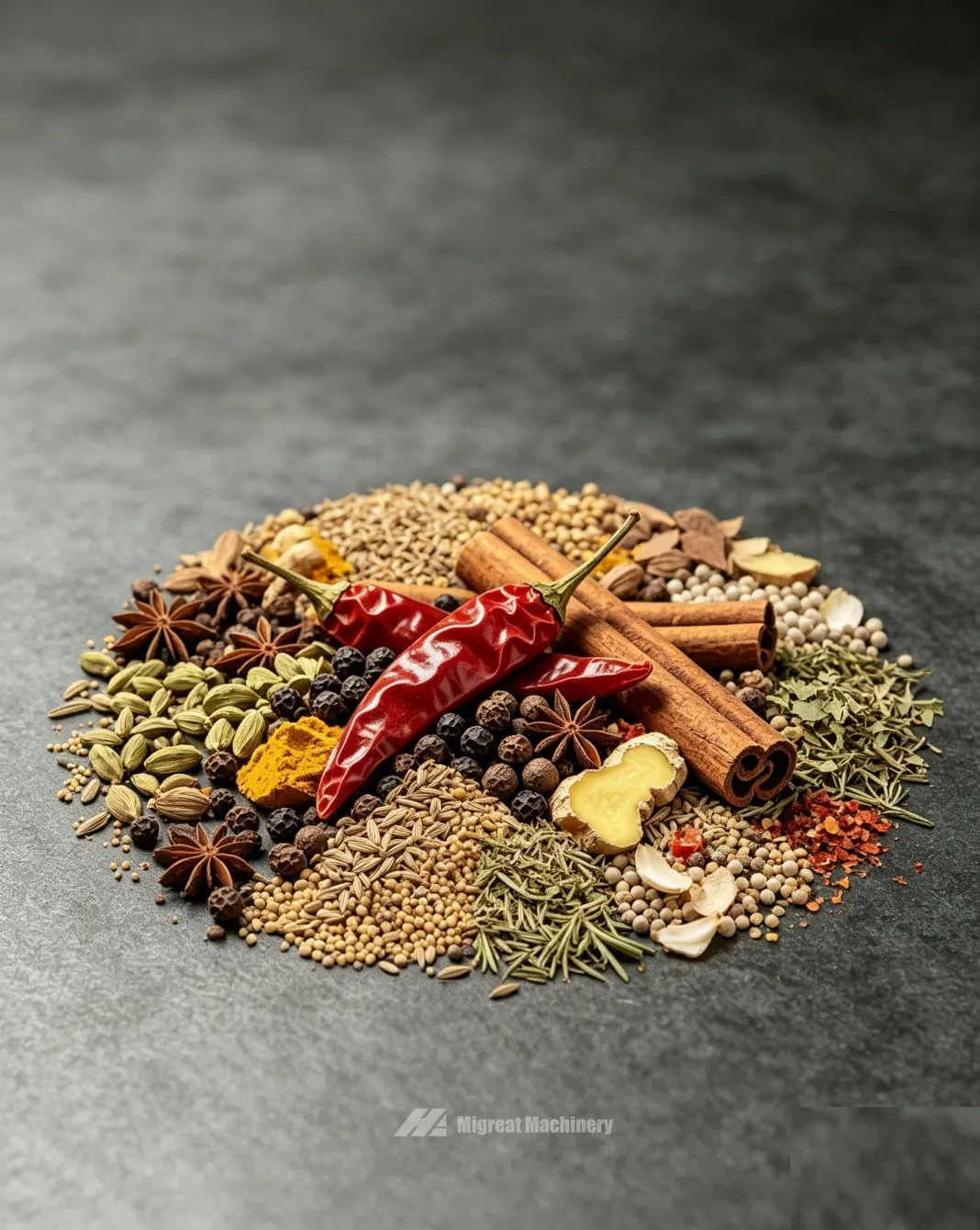
A complete spice powder line has four stages: coarse crushing, fine grinding, screening and packaging.
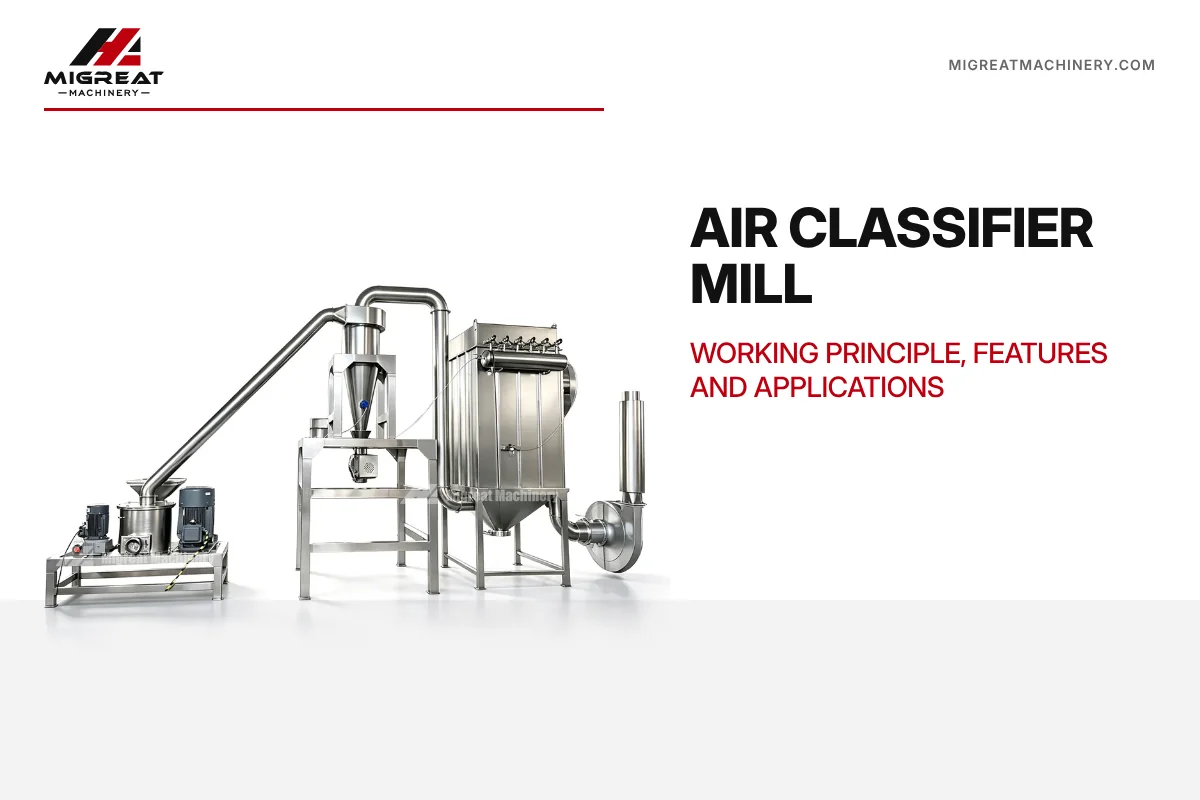
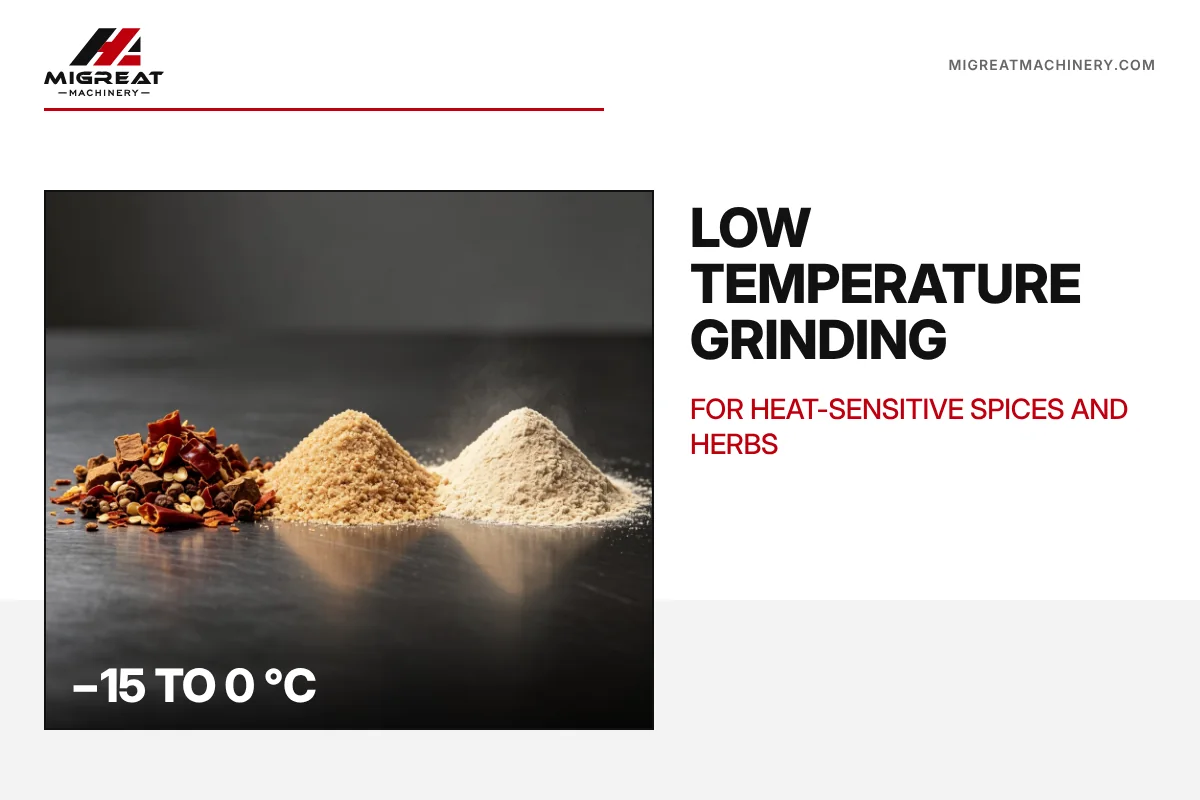
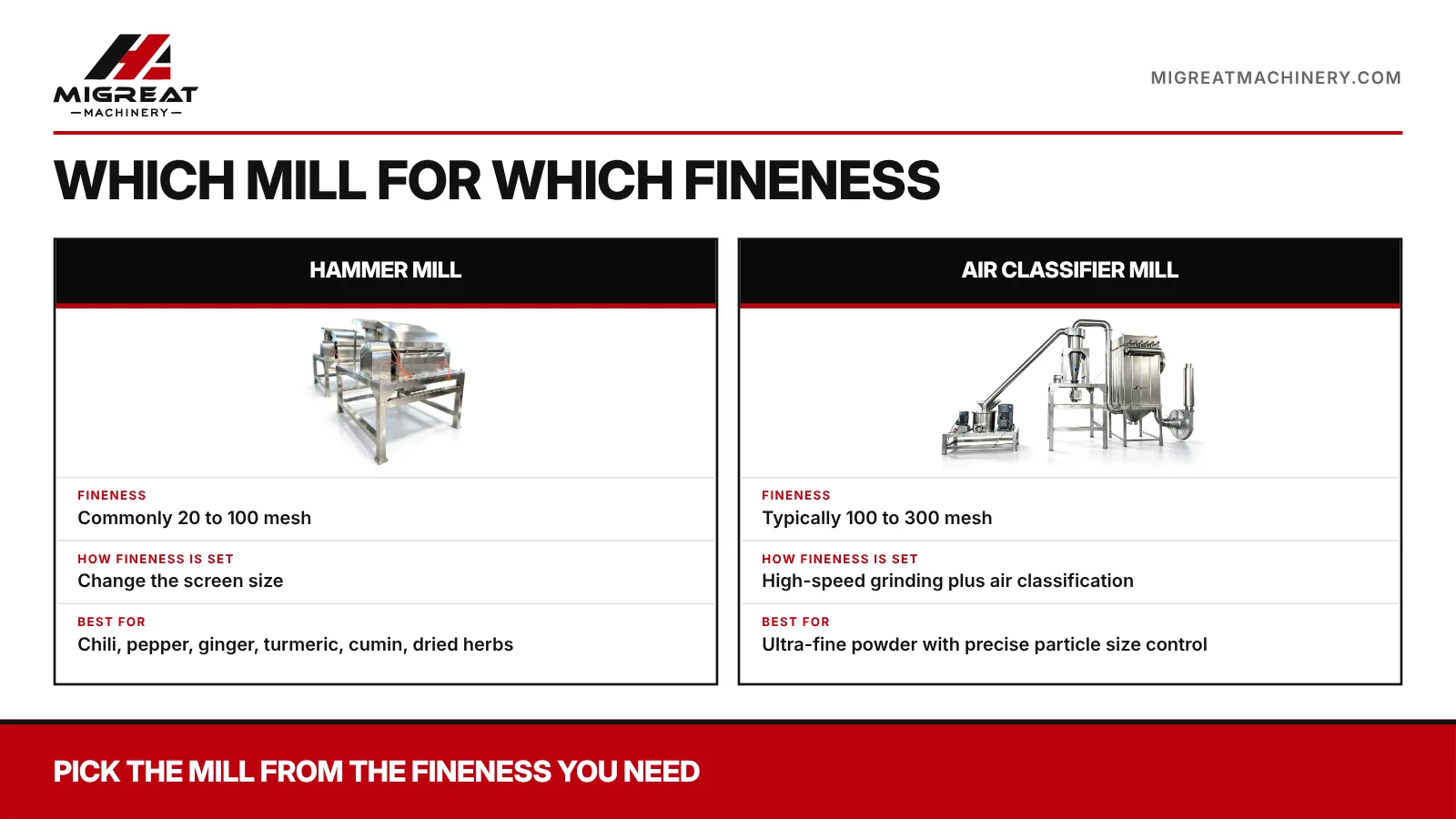
A hammer mill is widely used for most spices and commonly reaches 20 to 100 mesh. An air classifier mill gives finer powder, typically 100 to 300 mesh. Heat-sensitive or oily spices benefit from cold air grinding at about −15 ℃ to 0 ℃.
- Raw spices, coarse crusher, screw conveyor, grinder, screening, packaging
- Hammer mill: flexible fineness through screen changes
- Air classifier mill: finer powder with precise size control
- Cold air keeps colour, aroma and screens clean
Spices play an important role in the food industry, and producing high-quality spice powder requires not only efficient grinding equipment but also a complete processing solution.
Different spices have different characteristics, such as hardness, fiber content, oil content, and heat sensitivity. Choosing the right spice grinding machine and processing method is essential for consistent powder quality. A complete production process usually includes coarse crushing, fine grinding, screening, and packaging, and the grinding equipment is selected according to the required fineness and the material.
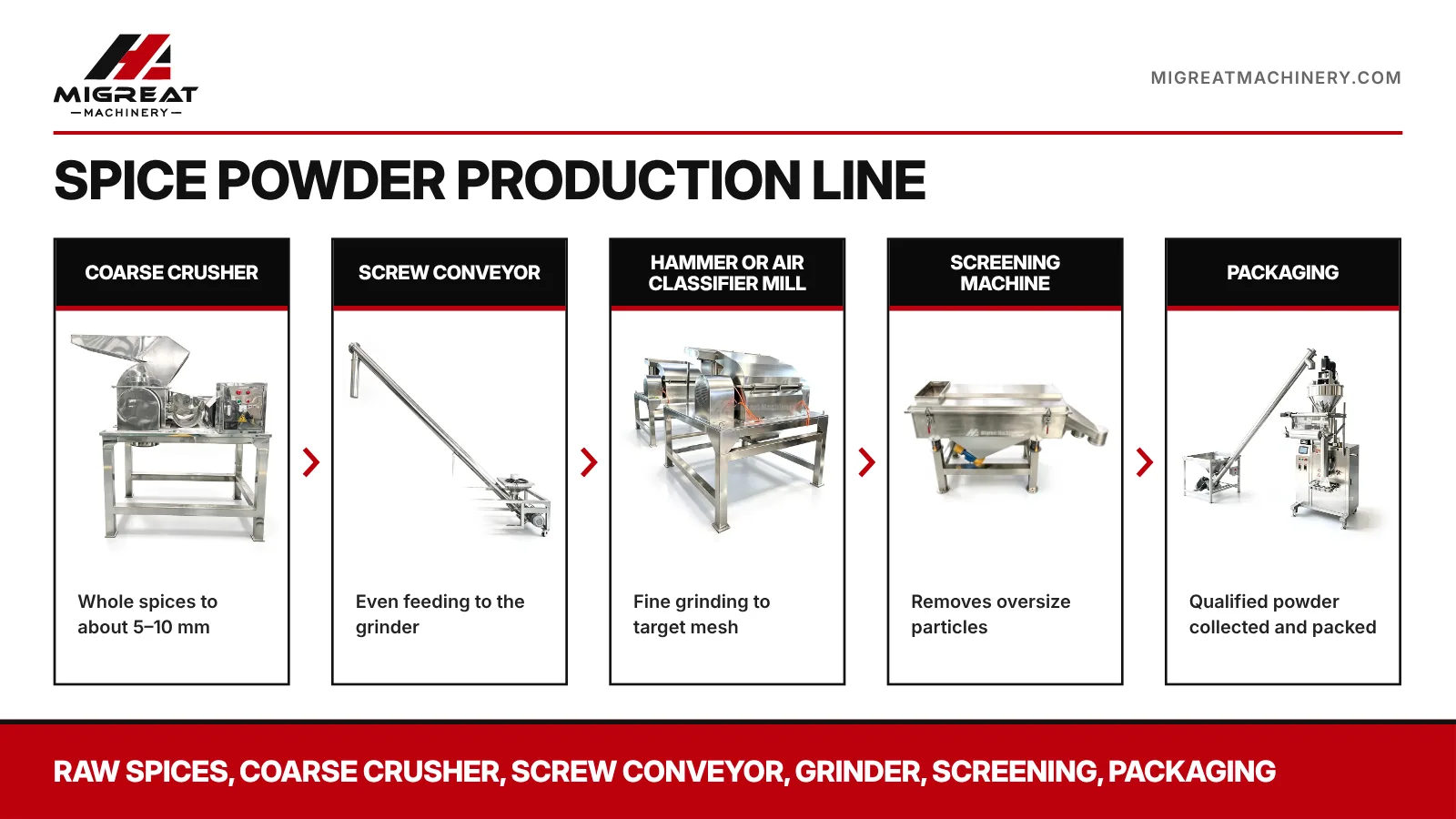
Complete process of spice powder production
Coarse crushing of raw spices
Whole spices such as chili, pepper, ginger, turmeric and dried herbs have large particle sizes. Feeding them straight into a fine grinder can reduce efficiency and make production unstable. A coarse crusher is usually the first step, reducing large pieces to normally around 5–10 mm. This gives the next stage more uniform feeding and improves line efficiency.
Fine grinding
After coarse crushing, a screw conveyor transfers the material to the grinding machine for further size reduction. See the comparison below for choosing between the two main mills.
Screening and final powder collection
After grinding, the powder is conveyed to a screening machine for final particle size separation. Screening removes oversized particles and ensures consistent quality; qualified powder is then collected and sent to packaging.

Fine grinding: hammer mill or air classifier mill
For most spice powder applications, a hammer mill is widely used because of its high grinding efficiency and flexible particle size adjustment. By changing screen sizes, the final fineness is controlled to customer requirements. For ultra-fine powder, an air classifier mill combines high-speed grinding with air classification for tighter particle size control.


Low temperature grinding for heat-sensitive spices
Many spices contain natural essential oils and heat-sensitive components. Excessive temperature rise during grinding can affect the colour, aroma and quality of the powder. For these materials a cold air grinding system can be integrated with the grinder. Low-temperature air introduced into the grinding chamber keeps the environment suitable; the cooling air is typically controlled between −15 ℃ and 0 ℃, depending on the material and production requirements. Read the full guide: low temperature grinding.
Maintain natural colour and aroma
Less heat generation during grinding protects the natural characteristics of spices.
Prevent oil release and screen blocking
Oily spices can release oil when hot, causing powder adhesion and screen blockage. Temperature control reduces this.
Improve production stability
A stable grinding temperature gives more consistent powder and longer operating time.
How to choose the right spice grinding machine
Conclusion
A successful spice powder production process requires more than just a grinding machine. A complete solution including coarse crushing, fine grinding, screening, and temperature control can significantly improve production efficiency and powder quality.
Migreat Machinery provides customized spice processing solutions, including spice grinding machines, hammer mills, air classifier mills, screening machines and conveying equipment, helping customers produce high-quality spice powders for different applications.